The Law
Establishes the covenant foundation: holiness, sacrifice, priesthood, sanctuary, blessing, rebellion, warning, judgment, and restoration.
Leviticus 26 · Deuteronomy 28
Scripture-centered books by Kevin L. Walker, with complete front covers, expanded descriptions, and cinematic introductions.
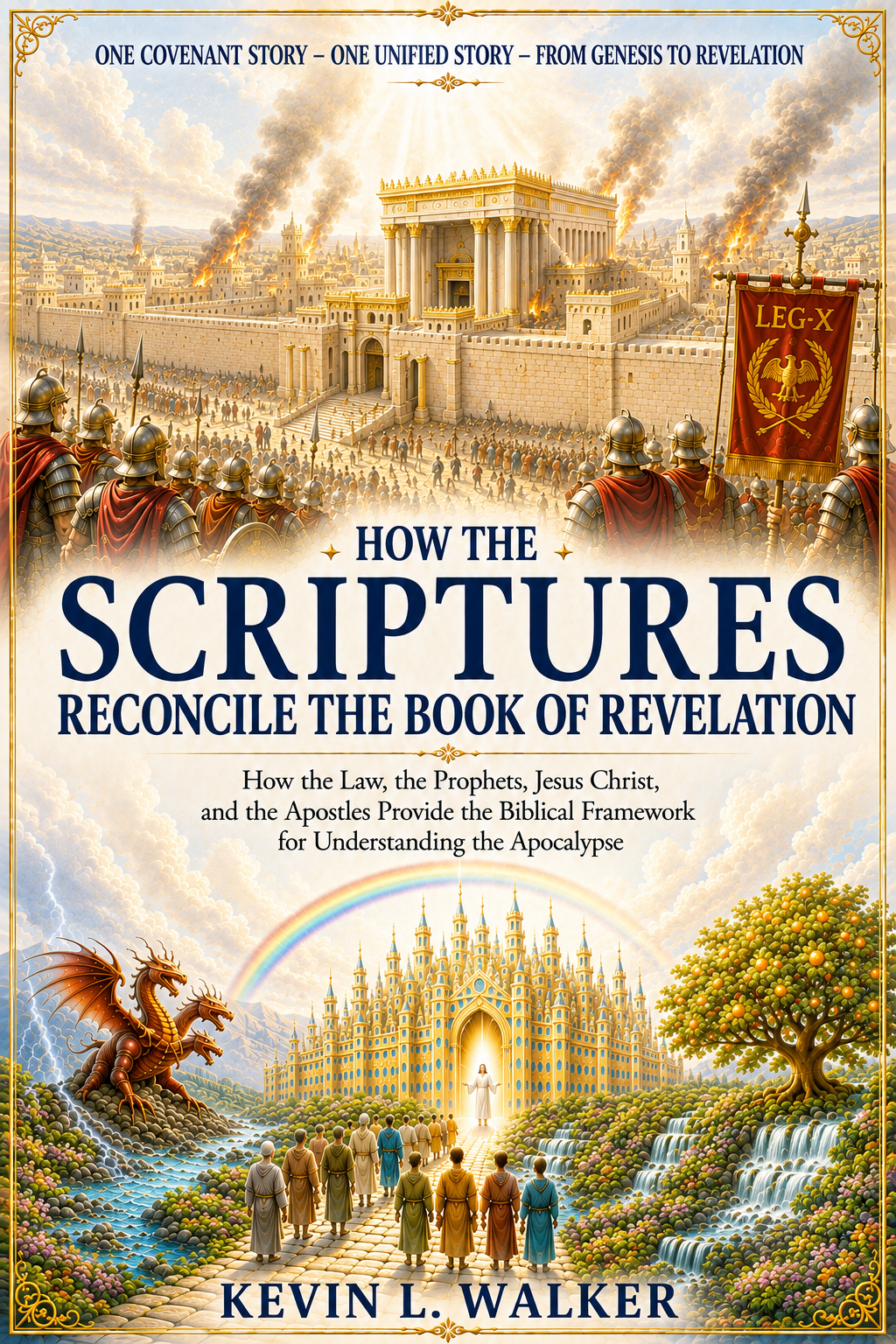
How the Law, the Prophets, Jesus Christ, and the Apostles Provide the Biblical Framework for Understanding Revelation
This Scripture-centered study approaches Revelation through the biblical framework God had already established before John received the vision. Rather than beginning with modern prophetic systems, the study follows the language, covenant patterns, warnings, judgments, promises, symbols, and doctrinal explanations found throughout God’s Word.
The progression is deliberate: Law → Prophets → Jesus Christ → Acts → Epistles → Revelation. Earlier Scripture supplies the vocabulary and patterns that Revelation uses, while Jesus and the apostles provide inspired explanations that help establish the controlling framework for interpretation.
The purpose is to allow Scripture to interpret Scripture, examine Revelation in light of its original audience and biblical background, and demonstrate the harmony of God’s Word from the Law to Revelation.
Author: Kevin L. Walker
ISBN: 979-8-9977936-0-9
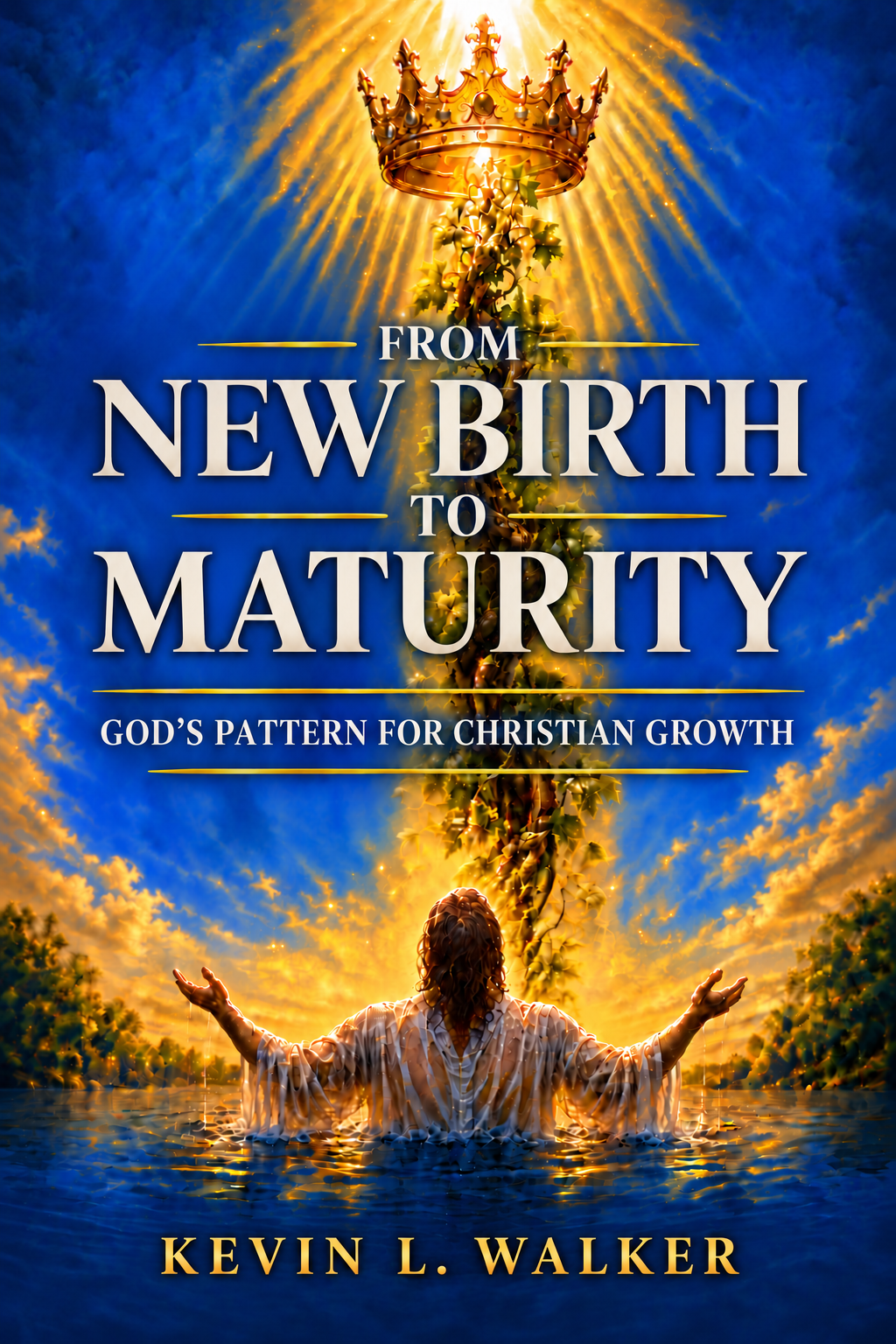
God’s Pattern for Christian Growth
Becoming a Christian is the beginning of a new life, not the end of spiritual development. From New Birth to Maturity follows the New Testament pattern of Christian growth from conversion and the sincere milk of the Word toward deeper knowledge, stronger roots, a renewed mind, spiritual fruit, faithful service, and maturity in Christ.
The study addresses the foundations a new Christian needs while continuing into doctrine, biblical authority, worship, Christian living, spiritual development, faithfulness, and the responsibilities that accompany maturity.
Its purpose is practical as well as doctrinal: to help Christians understand not only how spiritual life begins, but how God expects that life to develop, bear fruit, endure trials, serve others, and remain faithful.
Author: Kevin L. Walker
ISBN: 979-8-9977936-1-6
Book 1 companion resource
Revelation stands at the end of a biblical development that begins long before John. Follow the progression Scripture establishes before interpreting the final prophetic book.
Establishes the covenant foundation: holiness, sacrifice, priesthood, sanctuary, blessing, rebellion, warning, judgment, and restoration.
Leviticus 26 · Deuteronomy 28
Develop the covenant patterns and prophetic vocabulary: harlotry, Babylon, beasts, horns, the Day of the LORD, the Son of Man, the Shepherd, living waters, judgment, and restoration.
Isaiah · Jeremiah · Ezekiel · Daniel · Zechariah
Fulfills and applies the established patterns. The Lamb, Son of Man, Shepherd, pierced One, Davidic King, Temple, and New Covenant converge in Him.
Matthew 5:17 · Luke 22:20 · John 1:29
Records the historical realization: Christ is exalted, the Spirit is poured out, the church enters history, the Kingdom is proclaimed, and the Gospel moves toward the nations.
Acts 1:8 · 2:32–36 · 28:30–31
Explain the New Covenant meaning: Christ reigns, Jew and Gentile are one body, God's people are His Temple and priesthood, the church is Christ's Bride, and death is the last enemy.
Ephesians 2:14–22 · Hebrews 8–10 · 1 Corinthians 15:25–26
Gathers the already-developed biblical patterns into its final inspired visions. Its symbols are read through Scripture, Christ, the New Covenant, and Revelation's own immediate context.
Revelation 1:1 · 1:20 · 21–22
Book 1 companion resource
Use these controls as a concise guide while studying Revelation. They summarize the method of How the Scriptures Reconcile the Book of Revelation without reproducing the book.
A repeated biblical image or pattern supplies legitimate background. Similar language alone does not prove that two passages describe the same event, person, city, kingdom, or judgment.
1 Corinthians 2:13 · Revelation 1:20
When inspired Scripture explains a symbol, names its referent, or directly states a fulfillment, that explanation receives controlling weight. Revelation itself interprets several of its symbols.
Daniel 7:17, 23–24 · Revelation 1:20; 12:9; 17:12, 15, 18
Earlier Scripture may establish how imagery functions without determining Revelation’s particular application. The earlier passage provides the category; Revelation’s context supplies the application.
Isaiah 13:1, 10, 17 · 34:4 · Revelation 6:12–14
Where several independent Scriptural lines converge, an identification may become warranted. A cumulative conclusion should not be described as explicit unless the inspired text itself makes it explicit.
Isaiah 1:21 · Ezekiel 16; 22–23 · Matthew 23:29–38 · Revelation 17–18
The Law establishes covenant responsibility, warning, refusal, intensified judgment, and calls to repentance. The Prophets repeatedly apply that framework to covenant rebellion.
Leviticus 26 · Deuteronomy 28 · Ezekiel 14:21
Prophetic harlotry is covenant-betrayal imagery. Isaiah, Jeremiah, and Ezekiel apply it to an unfaithful covenant people and city; Revelation’s harlot must be evaluated within that established category.
Isaiah 1:21 · Jeremiah 3 · Ezekiel 16; 23 · Revelation 17
Daniel explicitly places beasts in the category of kings and kingdoms and horns in the category of rulers. Revelation develops that political-kingdom vocabulary and also explicitly identifies its ten horns as kings.
Daniel 7:17, 23–24 · Revelation 13:1–7; 17:12
Isaiah and Jeremiah establish Babylonian judgment vocabulary. Revelation reuses that vocabulary, but the source of the imagery must be distinguished from the identity of the city to which John applies it.
Isaiah 13–14 · Jeremiah 50–51 · Revelation 17–18
Temple imagery must pass through Christ and the New Covenant. Jesus identifies His body as the Temple; the apostles identify God’s people as His Spirit-indwelt Temple; New Jerusalem culminates in God and the Lamb as its Temple.
John 2:19–21 · Ephesians 2:19–22 · Revelation 21:22
Daniel promises the everlasting Kingdom, Jesus announces it, Acts proclaims the exalted King, and the Epistles describe believers as already transferred into Christ’s Kingdom. Revelation portrays its conflict and consummation.
Daniel 2:44; 7:13–14 · Acts 2:32–36 · Colossians 1:13 · Revelation 1:9
The Epistles identify the church in the bridal relationship to Christ and connect New Covenant believers with heavenly Jerusalem. Revelation identifies the Bride as the Lamb’s wife and shows her as holy Jerusalem.
Ephesians 5:25–32 · Hebrews 12:22–24 · Revelation 21:9–10
Revelation defines victory before the Beast appears: repentance, fidelity, holiness, endurance, and faithfulness to Christ—even unto death. Overcoming is allegiance to the Lamb, not worldly power or guaranteed physical survival.
Revelation 2–3 · 12:11 · 14:12
Book 1 companion resource
This plan follows the book’s own order rather than beginning with Revelation. Read the assigned portion of the book with the listed Scriptures open, then use the study focus to trace what Scripture has already established.
Read the Preface, How to Use This Book, and Introduction. Establish the controlling question: How has God already taught us to understand Revelation’s language?
1 Corinthians 2:13 · 2 Timothy 3:16–17 · Revelation 1:1
Study Chapter 1. Trace covenant blessing, rebellion, warning, intensified judgment, exile, and restoration.
Leviticus 26
Study Chapter 2. Observe how covenant consequences are expanded before Israel enters the land.
Deuteronomy 28 · 32
Study Chapter 3. Watch the Prophets take covenant categories and develop prophetic judgment language.
Isaiah 1 · 13 · 34
Study Chapter 4. Distinguish the historical Babylonian setting from the prophetic vocabulary later Scripture can reuse.
Jeremiah 3 · 31:31–34 · 50–51
Study Chapter 5. Trace covenant-harlot imagery, divine judgment, God’s glory, and restoration.
Ezekiel 5 · 14:21 · 16 · 23
Study Chapter 6. Let Daniel’s explicit interpretations establish how beasts and horns function in prophetic Scripture.
Daniel 2 · 7
Study Chapter 7. Note the imagery that later reappears without assuming that similarity alone proves identical fulfillment.
Zechariah 1 · 4 · 6 · 12–14
Study Chapter 8. Follow the established patterns as they converge upon Christ and the New Covenant.
Matthew 5:17 · 23–24 · Luke 22:20 · John 1:29
Study Chapter 9. Observe the exalted King, the outpoured Spirit, the church entering history, and the Gospel moving outward.
Acts 1:8 · 2:32–47 · 8:12 · 28:30–31
Study Chapter 10. Establish the apostolic meaning of Kingdom, Temple, priesthood, Bride, covenant people, resurrection, and victory before entering Revelation.
Ephesians 2:14–22 · Hebrews 8–10 · 1 Corinthians 15:25–26
Begin Chapter 11 and its introduction. Review the accumulated biblical framework before working through John’s visions.
Revelation 1:1–3 · 22:6–10
Study Christ’s opening revelation and note where Revelation interprets its own symbols.
Revelation 1
Study repentance, faithfulness, holiness, endurance, and overcoming before the judgment visions begin.
Revelation 2–3
Keep the sovereignty of heaven at the center of everything that follows.
Revelation 4
Study the victory of Christ through the imagery of the conquering Lion who appears as the slain Lamb.
Revelation 5
Compare the opening judgments with the covenant-judgment background already established.
Revelation 6 · Leviticus 26 · Ezekiel 14:21
Study God’s people amid judgment: the sealed servants and the great multitude before the throne.
Revelation 7
Trace the first six trumpets and compare their judgment vocabulary with the earlier biblical background.
Revelation 8–9 · Exodus 7–10
Study the prophet’s renewed commission and the movement toward the completion of the trumpet sequence.
Revelation 10
Study the Temple, two witnesses, great city, and seventh trumpet in their immediate context and earlier biblical setting.
Revelation 11
Follow Revelation’s own identifications and the biblical story behind the conflict.
Revelation 12 · Genesis 3:15
Bring Daniel’s beast-and-kingdom vocabulary forward while allowing Revelation’s context to determine its application.
Revelation 13 · Daniel 7
Contrast the Lamb’s people with Babylon and follow the chapter’s movement toward harvest and judgment.
Revelation 14
Study the Song of Moses and the Lamb, the seven bowls, the great city, and the completion of wrath.
Revelation 15–16 · Exodus 15
Bring together the prophetic harlot background, the Beast, the great city, Babylon language, and the cumulative evidence presented in the text.
Revelation 17–18 · Isaiah 1:21 · Ezekiel 16 · Matthew 23:29–38
Study heaven’s rejoicing, the marriage of the Lamb, and Christ as the victorious King.
Revelation 19
Follow the chapter in its place within the book’s accumulated Scriptural framework, including the defeat of Satan and the final judgment.
Revelation 20 · 1 Corinthians 15:25–26
Follow the biblical story to God dwelling with His people, the Bride, the River and Tree of Life, the removal of the curse, and the final invitation.
Revelation 21–22 · Genesis 2–3 · Hebrews 12:22–24
Study Chapter 12. Follow the concluding progression from the Gospel to Christ’s redeemed church, the Bride, New Jerusalem, the Book of Life, and restored access to the Tree and Water of Life.
Romans 1:16 · Acts 2:38–47 · Galatians 3:27 · Revelation 2:10; 21:9–10, 27; 22:2–5, 14, 17
Book 1 companion resource
Use this workbook with How the Scriptures Reconcile the Book of Revelation. The questions send the student back to the Scriptures and the corresponding portion of the book rather than substitute for either.
Read: Introduction; Chapters 1–2.
Scripture: Leviticus 26; Deuteronomy 28; 32.
Read: Chapters 3–4.
Scripture: Isaiah 1; 13; 34; Jeremiah 3; 31:31–34; 50–51.
Read: Chapters 5–7.
Scripture: Ezekiel 16; 23; Daniel 2; 7; Zechariah 1; 4; 6; 12–14.
Read: Chapter 8.
Scripture: Matthew 5:17; 23–24; Luke 22:20; John 1:29; 2:19–21.
Read: Chapters 9–10.
Scripture: Acts 2; Ephesians 2:14–22; Hebrews 8–10; 1 Corinthians 15:25–26.
Read: Revelation sections 1–5.
Scripture: Revelation 1–5.
Read: Revelation sections 6–11.
Scripture: Revelation 6–11; Exodus 7–10; Ezekiel 14:21.
Read: Revelation sections 12–14.
Scripture: Revelation 12–14; Daniel 7.
Read: Revelation sections 15–18.
Scripture: Revelation 15–18; Isaiah 1:21; Ezekiel 16; Matthew 23:29–38.
Read: Revelation sections 19–20.
Scripture: Revelation 19–20; 1 Corinthians 15:25–26.
Read: Revelation sections 21–22.
Scripture: Revelation 21–22; Genesis 2–3; Hebrews 12:22–24.
Read: Chapter 12.
Scripture: Romans 1:16; Acts 2:38–47; Romans 6:3–4; Galatians 3:27; Revelation 2:10; 21:9–10, 27; 22:2–5, 14, 17.
Book 1 companion resource
This guide corresponds directly to the twelve Student Workbook units. It supplies teaching objectives and answer direction while keeping the open Bible and the book—not the guide—as the primary material.
Objective: Establish the method before interpreting symbols.
Answer direction: Identify covenant relationship → rebellion → warning → escalating judgment → exile/desolation → restoration/mercy. Repetition establishes background, not automatic identity.
Objective: Show how prophetic writers develop covenant vocabulary.
Answer direction: Isaiah demonstrates covenant lawsuit and prophetic judgment imagery; Jeremiah develops covenant betrayal, historical Babylon, and the promised New Covenant. Distinguish an imagery source from a later referent.
Objective: Separate explicit prophetic interpretation from thematic background.
Answer direction: Ezekiel supplies covenant-harlot and restoration categories. Daniel explicitly interprets beasts as kings/kingdoms and horns as kings. Zechariah expands prophetic imagery without automatically fixing Revelation's application.
Objective: Make Christ and the New Covenant the interpretive turning point.
Answer direction: Jesus fulfills the Law and Prophets, establishes the New Covenant, applies prophetic judgment language, and identifies His body as the Temple. Give full weight to His stated audience and time markers.
Objective: Establish apostolic definitions before Revelation.
Answer direction: Acts records the exalted King, Spirit, church, Kingdom proclamation, and Gospel expansion. The Epistles explain New Covenant Temple, priesthood, Bride, heavenly Jerusalem, resurrection, and Christ's reign.
Objective: Begin Revelation with its own explicit explanations and Christ-centered setting.
Answer direction: Emphasize Revelation 1's interpreted symbols, repentance and faithfulness in chapters 2–3, God's sovereign throne in chapter 4, and the Lion/Lamb victory in chapter 5.
Objective: Compare judgment imagery without forcing one-to-one correspondences.
Answer direction: Recognize covenant and Exodus backgrounds while preserving John's own sequence. Require contextual evidence for conclusions about the Temple, witnesses, and great city.
Objective: Use explicit identification and Daniel's established categories carefully.
Answer direction: Revelation identifies the dragon; Daniel supplies the beast/kingdom category. Trace worship, allegiance, endurance, the Lamb's people, Babylon's announced fall, and harvest judgment.
Objective: Teach cumulative evidence without overstating certainty.
Answer direction: Begin with Revelation's explicit identifications, then add prophetic harlotry, covenant judgment, blood-guilt, Babylon vocabulary, and immediate context. Label the conclusion according to the certainty the text supports.
Objective: Keep Christ's victory and the defeat of every enemy central.
Answer direction: Trace rejoicing, marriage, the victorious King, judgment, Satan's defeat, resurrection/judgment language, and the second death alongside apostolic teaching of Christ's reign.
Objective: Show the Bible's closing restoration in light of its beginning.
Answer direction: Compare Genesis and Revelation: God's dwelling, Tree and River of Life, curse, death, dominion, and fellowship. Revelation shows the Bride as holy Jerusalem and closes with invitation and grace.
Objective: End with the practical Gospel question raised by Revelation's redeemed people.
Answer direction: Trace the concluding progression: Gospel → obedient faith → baptism into Christ → the Lord's church → faithfulness → Bride → New Jerusalem → Book of Life → Tree and Water of Life.
Book 1 companion resource
Use these terms consistently while tracing Revelation through the rest of Scripture. They are designed to keep the study within what the inspired text can actually support.
Inspired Scripture supplies the controlling framework. Begin with what God has already revealed and follow the inspired development rather than importing a system into the text.
A recognizable way Scripture presents a truth, image, judgment, people, enemy, or redemptive reality. A pattern establishes legitimate background; it does not by itself identify Revelation's referent.
Later inspired writers may expand, clarify, or apply an earlier pattern. That development must be followed before the imagery is carried into Revelation.
The surrounding inspired text determines how an established pattern is being used in the passage at hand. Earlier parallels cannot override the immediate context.
Scripture itself interprets the symbol, names the person or place, or directly states the fulfillment. When the inspired text identifies something explicitly, that explanation governs the study.
Earlier Scripture demonstrably uses the same or closely corresponding imagery in a particular way. This establishes a biblical category or background, but not automatically Revelation's specific application.
Several independent lines of Scriptural evidence converge upon the same conclusion. Such a conclusion may be warranted, but it should not be called explicit unless Scripture itself makes it explicit.
A later passage should be called a direct fulfillment only when the inspired text warrants that relationship. Similar wording or imagery alone is not sufficient.
The passage that supplies an image is not necessarily the person, city, kingdom, or event to which Revelation applies that image. Keep the origin of the vocabulary distinct from its later referent.
State the evidence at the level the text supports: explicit identification, established biblical background, or cumulative conclusion. Do not strengthen a conclusion beyond its Scriptural support.
Ignoring earlier Scripture: Do not read Revelation's language as though John invented its biblical vocabulary.
Forcing every similarity: Do not assume that every verbal or visual parallel proves the same event, person, city, kingdom, or judgment.
Book 1 chart
This chart keeps the interpretive order used throughout How the Scriptures Reconcile the Book of Revelation visible at a glance.
Covenant responsibility, holiness, sacrifice, priesthood, sanctuary, blessing, rebellion, and judgment.
Covenant lawsuit, harlotry, Babylon, beasts and kingdoms, judgment imagery, restoration, Messiah, and living waters.
The Law and Prophets converge in Christ, the New Covenant, the Kingdom, and His warnings of covenant judgment.
The exalted Christ, the outpouring of the Spirit, the church entering history, Gospel expansion, and faithful witness.
Christ's completed work, New Covenant meaning, Kingdom, church, Temple, priesthood, Bride, endurance, resurrection, and hope.
The already-developed biblical themes are gathered into the final inspired visions centered on Jesus Christ.
Creation → Fall → Promise → Covenant → Prophecy → Christ → Gospel → Church → Judgment → Victory → Restoration
Book 1 chart
The Law establishes the covenant-judgment framework; Israel and Judah demonstrate it in history; the Prophets develop its language; Jesus applies that established language to Jerusalem; Revelation gathers the biblical judgment vocabulary into its visions.
Leviticus establishes covenant responsibility, warnings, correction, repeated refusal, increasing consequences, and desolation. Deuteronomy expands the national pattern through invasion, siege, famine, captivity, scattering, and foreign domination.
Leviticus 26:14–45 · Deuteronomy 28; 30:1–10
Israel rejects God's covenant and prophets. Chastisements are followed by the repeated refrain that the people have not returned to God. The progression culminates in Assyrian captivity and removal.
2 Kings 17:3–18 · Amos 4:6–11
Judah transgresses, receives repeated warnings, rejects God's messengers until there is “no remedy,” and then experiences siege, famine, sword, Temple destruction, captivity, and desolation.
2 Chronicles 36:14–21 · 2 Kings 25:1–21
The Prophets apply and expand the Mosaic covenant vocabulary: covenant lawsuit, sword, famine, pestilence, beasts, Day-of-the-LORD imagery, harlotry, bloodguilt, desolation, restoration, and divine use of earthly powers.
Isaiah 1 · Jeremiah 7 · Ezekiel 14:21; 16 · Daniel 7
Jesus condemns Jerusalem's accumulated bloodguilt, laments its refusal, declares its house desolate, foretells the Temple's destruction, and describes armies, distress, sword, captivity, vengeance, and wrath upon that people.
Matthew 23:29–38; 24:1–34 · Luke 21:20–24
Revelation employs already-established judgment forms: repeated warnings, refusal to repent, conquest, famine, death, plague imagery, sevenfold judgment sequences, desolation, blood avenged, and the fall of the great city.
Revelation 2–3; 6; 8–9; 15–19
Exodus supplies the foundational plague-and-deliverance pattern: an oppressive power is judged while God delivers His people. Leviticus and Deuteronomy supply a different category—covenant punishment upon God's own rebellious covenant nation. Revelation draws upon both streams; they should not be collapsed into one.
Leviticus 26 repeatedly warns of punishment intensified “seven times.” Revelation presents seven seals, seven trumpets, and seven bowls. The book treats this as an established sevenfold judgment framework—not as a claim that Moses supplied twenty-one individually numbered curses corresponding one-for-one with Revelation's twenty-one numbered judgments.
Book 1 chart
Revelation 17 does not present the woman and the Beast as interchangeable names for the same entity. The woman rides the Beast, the Beast carries her, and the Beast's own horns eventually turn against and destroy her.
Danielic category: ruling kingdom / political power
Daniel 7:17, 23–24 · Revelation 13 · 17:3, 7, 12, 16
Prophetic category: covenant unfaithfulness
Isaiah 1:21 · Ezekiel 16; 23 · Revelation 17:1–6, 16, 18
Harlot → rides / is supported by → Beastly power → whose horns later → destroy the harlot
Explicit: the woman and Beast are distinct; the horns are kings; the woman is “that great city.” Biblical background: Daniel supplies the Beast/kingdom category, while Isaiah and Ezekiel supply covenant-harlot imagery. Cumulative conclusion: the book identifies the harlot/Babylon with apostate Jerusalem and the Beast with Roman imperial power; Revelation itself does not explicitly name either symbol with those historical labels.
Book 1 chart
Revelation deliberately contrasts covenant corruption with covenant faithfulness. The harlot is judged; the Bride belongs to the Lamb and is shown in the glory of New Jerusalem.
Ephesians 5:25–32 · 2 Corinthians 11:2 · Revelation 19:7–8 · 21:9–10
Book 1 chart
The New Testament establishes a covenant distinction between “Jerusalem which now is” and “Jerusalem which is above” before Revelation portrays New Jerusalem in perfected glory.
Book 1 chart
Revelation's closing vision answers the problem introduced in Genesis: sin, curse, death, separation, and lost access to the Tree of Life give way to victory, restored fellowship, and God's permanent dwelling with His redeemed people.
Book 1 chart
The sanctuary pattern does not end by rebuilding what came earlier. Scripture develops the dwelling theme from the Tabernacle through Christ and His people until the purpose of the sanctuary reaches its completed goal in New Jerusalem.
“Let them make me a sanctuary; that I may dwell among them.”
Exodus 25:8The Old Covenant sanctuary becomes the center of Israel's worship.
1 Kings 8:10–11Jesus speaks of “the temple of his body.”
John 1:14; 2:19–21Christians are God's Temple and “an habitation of God through the Spirit.”
1 Corinthians 3:16; Ephesians 2:22God dwells permanently with His people; God and the Lamb are the Temple.
Revelation 21:3, 22Book 1 reference tools
Find subjects and Scripture references in How the Scriptures Reconcile the Book of Revelation. Page references follow the table of contents in the current Word manuscript. TOC headings use their stated start pages; other entries show the TOC section page ranges in which they occur. These ranges guide you to the relevant chapter rather than claim the exact page of each occurrence.
These indexes contain entry titles and printed page references; the book manuscript is not posted here. Select up to four Scripture references to compare their KJV passages in movable windows on this page.
| Chapter or section | Page |
|---|---|
| Acknowledgements | iv |
| Preface — Why This Book Was Written | vi |
| Theme Scripture | vi |
| How to Use This Book | vii |
| Additional Resources | viii |
| Introduction — The Journey Begins | ix |
| Chapter 1 — Leviticus: The Covenant-Judgment Pattern | 1 |
| Chapter 2 — Deuteronomy: Expanding the National Covenant Pattern | 10 |
| Chapter 3 — Isaiah: The Covenant Lawsuit and the Development of Prophetic Patterns | 20 |
| Chapter 4 — Jeremiah: Covenant Betrayal, Babylon, and the Promise of a New Covenant | 32 |
| Chapter 5 — Ezekiel: God’s Glory, the Covenant Harlot, Judgment, and Restoration | 46 |
| Chapter 6 — Daniel: Beasts, Kingdoms, and the Everlasting Kingdom | 61 |
| Chapter 7 — Zechariah: Expanding the Prophetic Vocabulary | 71 |
| Chapter 8 — Jesus Christ: The Fulfillment and Application of the Biblical Patterns | 81 |
| Chapter 9 — Acts: The Historical Realization of the Kingdom and the New Covenant People | 93 |
| Chapter 10 — The Epistles: The New Covenant Explained | 106 |
| Chapter 11 — Revelation: The Completion of God’s Covenant Story | 122 |
| Revelation 1 — the Revelation of the Reigning King | 130 |
| Revelation 2–3 — Christ Addresses His Covenant People | 141 |
| Revelation 4 — the Throne of God and the Sovereignty of Heaven | 154 |
| Revelation 5 — the Lion Who Conquers as the Slain Lamb | 162 |
| Revelation 6 — the Lamb Opens the Seals | 171 |
| Revelation 7 — the Sealed Servants and the Great Multitude | 182 |
| Revelation 8 — the Seventh Seal and the First Four Trumpets | 194 |
| Revelation 9 — the Fifth and Sixth Trumpets: the First Two Woes | 204 |
| Revelation 10 — the Little Book and the Prophet’s Commission | 215 |
| Revelation 11 — the Temple, the Two Witnesses, and the Seventh Trumpet | 226 |
| Revelation 12 — the Woman, the Male Child, and the Dragon | 243 |
| Revelation 13 — the Beasts, Political Power, and False Worship | 257 |
| Revelation 14 — the Lamb’s People, Babylon’s Fall, and the Harvest of Judgment | 274 |
| Revelation 15 — the Song of Moses and the Lamb, and the Final Plagues | 290 |
| Revelation 16 — the Seven Bowls, the Great City, and the Completion of Wrath | 301 |
| Revelation 17 — the Great Whore, the Beast, and the Identification of the Great City | 315 |
| Revelation 18 — Babylon the Great: the Covenant City Under Judgment | 332 |
| Revelation 19 — Heaven Rejoices, the Marriage of the Lamb, and the Victorious King | 347 |
| Revelation 20 — the Reign of Christ, the Defeat of Satan, and the Final Judgment | 362 |
| Revelation 21 — New Jerusalem, the Bride, and the Dwelling of God with His People | 379 |
| Revelation 22 — the River of Life, the Tree of Life, and the Completion of the Biblical Story | 396 |
| Chapter 12 — The Gospel, Christ’s Church, and New Jerusalem: Obeying the Gospel and Identifying the People Who Belong to Christ | 439 |
| About the Author | 491 |
Open this index to load its entries.
Open this index to load its entries.
Kevin L. Walker · Manuscript under review · ISBN 979-8-9977936-0-9